
Source: Medium
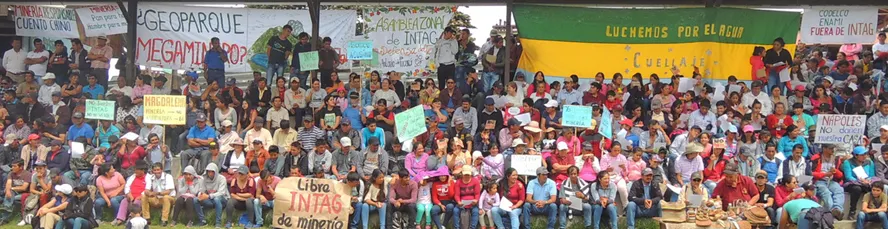
Since the 1990s, several transnational companies have tried to develop mining in the Toisán Mountain Range, one of the most biodiverse corners of Ecuador, and the world. Two of these companies were expelled by the communities due to the environmental and social impacts anticipated from a small copper mine. But greed didn’t subside, and since 2014, CODELCO, with the full support of the Ecuadorian state, tried and failed to open a mine. It will be the fourth mining company that has failed to do so just in the Llurimagua mining concession. In all, in the Intag region, five transnational mining companies from Japan, Australia, Canada (2), and Chile, plus Ecuador’s own ENAMI, have failed to develop their mining plans.
The sixth transnational to fail in Intag may very well be Hanrine, the Ecuadorian subsidiary of Australian Hancock Prospecting, who is investing heavily in trying to get its grubby hands on the Llurimagua concession.
If in the future, the mine would be permitted, it be responsible for one of the worst environmental disasters in the world.
Below, I go into detail below about the 25 reasons, but in summary, the most relevant reasons are:
a) The copper deposit site is covered by primary and secondary cloud forests — among the most biodiverse and threatened forests on the planet, where 101 endangered animal and plant species have been identified to date (09/2025).
b) According to a preliminary environmental study prepared by Japanese experts for a small copper mine, so much deforestation would occur that the local climate would dry out (the scientist used the terms “massive deforestation” and “desertification).
c) The copper deposit is highly contaminated with heavy metals, including lead, arsenic, cadmium, and chromium, among other lethal substances.
d) The mining area is located within the buffer zone of the Cotacachi-Cayapas National Park, one of the most important protected areas on the planet.
e) It is an area with extremely high rainfall (between 2,000 and 5,000 mm annually)
f) The topography is extremely steep
g) The entire mining area is considered a seismic zone crossed by multiple faults.
h) There are multiple pre-Incan unexplored archeological sites within the mining concession
h) There are 43 river and stream sources in the 4,339-hectare mining concessions
i) Hundreds of families from at least four communities would have to be relocated
It is worth repeating that all these impacts were highlighted in the Japanese-government funded preliminary environmental impact study. But there are many more……
The unprecedented environmental disaster announced is known as Llurimagua, a large-scale copper mining project. The area is known as Intag, a symbol of resistance to mining since 1995.
Here, in more detail, are the twenty-five reasons why it is REALLY a bad idea for any other mining company to invest in any mining activities in the Intag area.
IMPACTS
A. The impacts identified in this section are the environmental and social impacts predicted in the preliminary Environmental Impact Study for a small copper mine (450,000 tons of copper), prepared by Japanese professionals.
It should be noted that a couple of years after its publication, the Japanese suggested that the deposit could be five times larger than the one used to identify the impacts identified below. I think it is important to note that the study in question is the only environmental impact study for a mining project in Ecuador not funded by mining companies. 100% of the funding came from the Japan International Cooperation Agency (better known by its acronym JICA). What this means is that it is the only objective study done on the site.
1. Relocation> Intag is not like the Atacama Desert, where Codelco has its copper mines. Aside from being rich in biodiverse forests, the area is home to dozens of farming communities.
According to the aforementioned study, the mining project would relocate hundreds of families from four communities. Later, the Japanese found 2.5 times more copper, which would increase the number of affected communities. The relocation of communities alone is enough to put an end to almost any extractive project. (In 2020, the government estimates there could be 11 times more copper than was used to forecast the impacts reported here.)
2. It would impact primary cloud forests. Less than 2.5% of tropical forests are cloud forests, and apart from their importance in biodiversity conservation, they play an indispensable role in protecting water and biodiversity in the Andes, and stabilizing the climate.
3. The project would cause “massive deforestation” (the words of the Japanese experts). The small mine would directly affect 4,025 hectares. Deforestation would impact the forests’ ability to mitigate climate change.
4. This massive deforestation, according to the Japanese, would dry out the local climate, which would affect thousands of small farmers (the Japanese study used the term desertification).
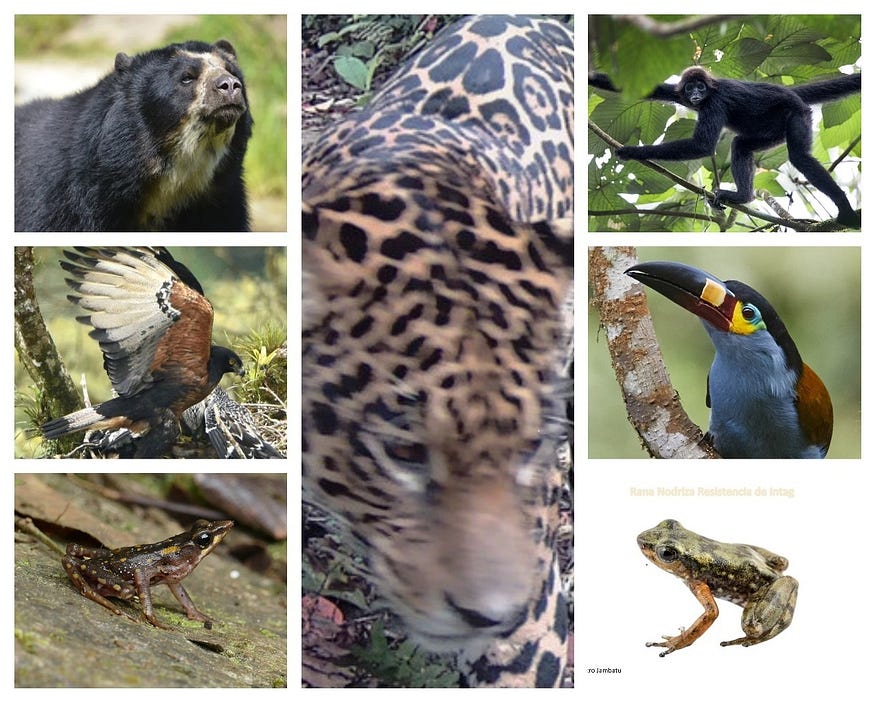
5. The Intag cloud forests belong to the world’s most important biodiversity hotspot, the Tropical Andes. Scientists conducting the study in the 1990s only identified 12 endangered mammal and bird species that would be affected by the project, including jaguars and spectacled bears. Besides the Jaguars and Andean Bear, new studies has identified 99 other species on the same endangered lists, including, three species of monkeys- the brown-headed spider monkey being one of the world’s most endangered primates.
In a much more studied nearby protected area near the mining concession, 114 endangered species have been identified (Los Cedros Protective Forest).
Other species on the lists of endangered species include the Linnaeus white-faced capuchin, and the Howler monkeys, the Andean bear, the collared Pecari, and eight orchid species. Thirty-four frog species are on the red lists, including the Atelopus longirostris, rediscovered in 2016, and a new species of the genus Ectopoglossus* (discovered in 2019), which have only been reported in the mining area and nowhere else on the planet. There is also a critically endangered fish species. Based on incomplete studies, biologist Bitty Roy and other biologists identified more than 200 endangered plant and animal species in this area (https://bit.ly/2ORqcvV).
6. WATER: The mining area is extremely rich in water resources. Within the Llurimagua concession, there are 43 headwaters of rivers and streams. The Japanese study predicted that the water resource would be contaminated with lead, arsenic, chromium, cadmium, and other toxic substances (recent environmental impact studies have detected mercury in the soil).
7. Archaeological heritage at risk. The project will undoubtedly destroy pre-Incan archaeological sites identified in all the environmental impact studies conducted by different companies (the most recent dating from 2018).
8. It would affect the Cotacachi-Cayapas National Park (one of the most biologically diverse protected areas in the world, according to the Japanese Impact Study). The entire Llurimagua mining concession is located within the National Park’s buffer zone.
*In May 2022, an international campaign voted to name the new rocket frog species Intag resistance.
In addition to these impacts identified in the Study (for a mine 10% of its potential size), there are other significant problems and obstacles.
B. Legal Obstacles
9. Large-scale mining would violate Cotacachi’s binding status as an Ecological Canton created in 2000. Only the Constitutional Court can rule on the validity of the ordinance in light of the new Constitution. And the Court has not done so.
– Constitutional Challenges: In 2020, civil society in Intag filed a precautionary measure based on the violation of the rights of nature. The case was won in the first instance, but the case was dismissed on appeal, not because of the merits of the case, but because of procedural errors by the lower court.
– On November 30, 2020, representatives of the communities within the area of influence filed a Constitutional Protection Action based on the violation of the rights of nature and the lack of prior environmental consultation.
– In March 2023, the Provincial Court of Imbabura ruled in favor of the communities and Nature and ordered the suspension of all mining activity within the mining concession and revoked the environmental license.
-One year later, the Supreme Court agreed with the provincial court, reaffirming the revocation of the environmental license. No mining activities whatsoever has taken place since then.
The failed International Arbitration and What it Reveals
Codelco brought two international arbitration against Ecuador for not complying with its obligation to develop the Llurimagua concession by creating a new company, which was part of a bi-lateral investment treaty between the company and Ecuador’s state mining company (Enami). The first arbitration was presented in 2021 to the Paris-based International Chamber of Commerce. It concluded in 2025 with a significant loss for Codelco. Of the nearly USD 600 million dollars the company was suing Ecuador for, the international arbitrators only granted USD 25 million. Significantly, the International Chamber of Commerce ruled that Codelco did not have to turn over its geological knowledge of the Llurimagua mining concession.
As a consequence of the ruling, as of August of 2025, Codelco’s Ecuadorian subsidiary, EMSAEC, fired most of its workforce in Intag. It’s an indication that the fourth mining company has been unable to develop the Llurimagua mine.
The second international arbitration was presented to the International Centre for Settlement of Investment Disputes (ICSID) on January 2022. To date (Sept 2025), it has not been resolved.
Added to the two arbitrations above is the one brought on by Copper Mesa against Ecuador in 2013, again, for breach of treaty obligations (I recommend watching the movie “The Tribunal”)
What these three (yes, three) international arbitrations reveal is that Ecuador is a great place to invest in mining company if you do not mind losing all, or nearly, all your investment.
10. The New Constitution grants nature and its components the right to exist and flourish. Therefore, the inherit right of specis like the long-nosed harlequin frog and the new species of the genus Ectopoglossus, among the 99 other species on the endangered lists, will always present a constitutional obstacle to the opening of any mine.
Furthermore, the same Constitution grants people the right to Sumak Kawsay, or Good Living; which is completely contrary to mining. The Constitution itself considers cloud forests a fragile ecosystem. According to the Organic Code of the Environment (Environmental Law), fragile ecosystems are essential to guaranteeing the right to Good Living (or wellbeing).
Environmental consultation. The other major constitutional inconvenience lies in the fact that mining, currently, violates the other community right to prior environmental consultation (Article 398), since the communities potentially affected by mining activities have never been legally consulted. Recently, three communities in Azuay, Sucumbíos, and the Waorani people of Pastaza have triumphed against the state for the lack of prior consultation. In Intag, as mentioned above, in 2024 the Supreme Court upheld the same constitutional rights.
The Los Cedros Case
At the end of 2020, the Constitutional Court ruled in favor of the Environmental Consultation related to the Canadian mining project Cornerstone, located in the Los Cedros Protective Forest, which is very close to the Llurimagua mining concession and shares the same habitat. The Court also ruled on the Rights of Nature, clarifying their scope and importance. The outcome of the ruling generated jurisprudence for cases such as Intag. As a result of the ruling, the Canadian company was forced to abandon the mining project, and the environmental license was suspended.
In other words, together with the 2024 Constitutional Court ruling in favor of the communities in Intag, there is strong legal precedent protecting the area’s rights of nature.
11. Greater protection.
In addition to the Ordinance that Declaring the Cotacachi Canton an Ecological Canton in 2000, in early 2019 the Cotacachi government approved the municipal ordinance establishing the Intag-Toisán Municipal Conservation and Sustainable Use Area (Acusmit), which imposes limitations on the use of natural resources and excludes mining activities.
– Geopark. Likewise, at the beginning of 2019, UNESCO declared the entire province of Imbabura a World GEOPARK, the first in Ecuador. Geopark territories must be managed under the axes of Conservation, Education, and Tourism.
In 2024, the Cotacachi government declared Intag a LIFE SANTUARY, putting into place even more restriction to mining activities.
And, if these conservation measures are deemed as not insufficient, mining companies should keep in mind that our organization (DECOIN) has worked hand-in-hand with local governments, communities and local groups in protecting over 12,000 hectares of forests, biodiversity and watersheds. The 38 community watershed reserves are distributed throughtout Intag and are in the hands of communities and local governments (In 2017 DECOIN was awarded the prestigious Equator Prize by the United Nations Development Programme in part, because of this innovative conservation mechanish).
C. Opposition. There is widespread opposition to the Intag mining project, including:
12. For the last more than 30 years now, the mining threat has mobilized more than 90% of organizations at the local, cantonal, and national levels that were not previously involved. If mining previously affected only Junín, it now affects the entire Intag region due to the irresponsible granting of mining concessions throughout the area.
13. Three decades of resistance have honed legal skills to stand up to mining, and communities are not giving up. The right to resist is now a constitutionally protected right.
To date, five transnational mining companies from five different countries, and the state-owned ENAMI has been unable to develop a single mine in Intag (Bishimetals (Japan), Copper Mesa (Canada); Cornerstone (Canada); BHP (Australia-UK) and Codelco (Chile).
14. On three occasions, the most important civil society organizations in Intag wrote to Chile’s presidents to ensure they understand that the organizations will defend the area if Codelco moves forward with the project.
In 2021, a letter signed by the majority of Intag organizations was delivered to the managers of the companies that hold mining concessions in Intag, as well as to President Lasso, the Ministers of Environment and Water, and the Minister of Energy and Non-Renewable Natural Resources, warning them of the environmental and social violations and risks associated with mining in the Intag region, and the Llurimagua project in particular. The most recent demonstration of opposition to Codelco’s presence in the Intag region occurred when six presidents of the parish governments in the Intag region officially addressed the Ministry of Environment, Water, and Ecological Transition. Their opposition to Codelco was due to the fact that one of the company’s mining concessions overlaps the Nangulvía Bajo community reserve. The reserve is one of 38 community hydrological and forest reserves that protect water resources and biodiversity in Intag, and which are in the hands of communities, organized groups, and local governments.
In November 2014, 100,000 signatures from citizens from around the world were delivered to the Chilean Consulate in Germany in support of the rejection of mining in Intag and in support of the communities in resistance.
In 2014, Ecuador’s national government and Codelco, after fruitlessly trying to socialize the mining project, used nearly 400 police and military personnel to violently impose the mining project. It was the only way Codelco could access its concession. The mining camp was even set up in the community forest used for community tourism. Codelco-funded exploration severely impacted tourism and the community forest, felling ancient trees and contaminating water sources (more information in the March 2019 Comptroller’s Report and in severaly Youtube shorts and full-feature documentaries, including Codelco en Intag).
D. Manipulation of the Deposit’s Content
15. In 2007, Micon International, the entity hired by Ascendant Copper to evaluate the Llurimagua copper deposit (then known as Junín), said it could not confirm its previous estimates due to sample degradation. Copper Mesa had been claiming that the Junín copper deposit had four times more copper than the Japanese had deduced after years of exploration. In total, 2.26 million tons were inferred (unverified) by the Japanese, which represents considerably less than a tenth of what the world consumes annually (and which would take decades to exploit). Inferred resources are the least reliable of the ore categories. CODELCO, for its part, in 2018, and without any support, magically increased the deposit to 3.846 billion tons of ore, containing only 0.44% copper (p. 103 https://www.codelco.com/memoria2018/). This translates to 17 million tons of copper, leaving 3,829 tons of waste destine to end up in the tailings ponds. The government, for its part, handles its own calculations. It says the potential deposit is 5.4 million tons of pure copper. In short, it is a deposit that has been manipulated to inflate the value of the project and attract investors. Unless there is independent evaluation of the on-site drilling reports, none of the above should be taken at face value.
16. The deposit area is a montane tropical forest and receives between 2,000 and 5,000 millimeters of precipitation per year (actual data from the Los Cedros reserve). Heavy rains and abundant groundwater, coupled with the heavy metal content in the deposit, are a deadly mix for any mining project. This situation significantly increases the cost of any mining project, while also greatly increasing the risks of anthropogenic disasters, such as landslides and tailings pond ruptures.
The terrible environmental and human tragedies that occurred in Brazil in November 2015, and the most recent, on January 25, 2019, are responsible for The death of nearly 300 people due to the collapse of a tailings pond should serve as a warning to all companies and governments of the true risks and costs of establishing mining projects in sites like Intag. After visiting the Llurimagua mining area, engineer Steven Emerman of Malach Consulting concluded that the risk of a tailings pond rupture within the mining concession or surrounding areas was the worst of the worst examples he knew of.
17. Perpetual impacts. The deposit contains arsenic and other heavy metals and is porphyry-type (which would cause Acid Mine Drainage). The contamination from AMD is perpetual.
18. According to the Japanese EIA, there is an overabundance of groundwater in the mining area. This should be very worrying for a mining project, as it greatly increases the cost of mining and causes enormous environmental problems.
19. The area is topographically very rugged, which also contributes to the cost of any large-scale mining and significantly increases the risk of tailings pond collapses and landslides, and therefore water contamination.
20. There are clear indications that the copper deposit in Junín are located very deep (according to the 1998 Japanese report). This makes mining environmentally much more destructive, and copper extraction economically less profitable.
21. The Toisán Mountain Range, where the copper deposit is located, contains numerous geological faults, which pose significant earthquake risks. Mining itself is a highly dangerous activity, but it is even more dangerous in places where seismic risks exist.
22. The Report of the Comptroller General’s Office and the Ombudsman’s Office
: In March 2019, the (national) Comptroller General’s Office published its final report* on the Special Examination of the Llurimagua mining project, documenting dozens of serious violations by the company and officials from various state institutions during the more than four years of Codelco’s presence in the Junín community forest. The violations and illegalities are too extensive to list in this text, but they were of such magnitude that the Comptroller General’s Office called the regulatory institutions’ attention for not insisting on the mining project’s cancellation. Similar to what was detected and reported by the Ombudsman’s Office, this evidence could be used by those affected in future legal actions.
The Ombudsman’s Office Report: In May 2019, the Ecuadorian Ombudsman’s Office also published its report on the Llurimagua mining project, revealing and denouncing serious human and collective rights violations as a consequence of the implementation of the Llurimagua mining project.
23. The devastating copper of the Toisán Mountains.
At a time when wealthy countries are creating mechanisms to avoid using materials for the energy transition identified as having serious environmental or social impacts, it will be impossible for any company to sell copper as socially and environmentally responsible. It will be, and the organizations will take care of it, seen as nothing less than lethal copper, linked to historical human rights violations, devastation of one of the most biodiverse forests on the planet, the extinction of endangered species, destruction of cultural heritage and the displacement of agricultural communities.
24. International Support.
Since the beginning of the resistance to mining, the communities have received support from highly prestigious international entities. Recently, even Hollywood actor Leonardo DiCaprio has vigorously joined in calling the world’s attention to the danger this project poses to communities, species on the brink of extinction, and the rights of nature. These campaigns will continue until Codelco, or any other company, leaves Intag, as the two other transnational corporations have done.
25. New Processes
It is important to note that the multiple legal actions and fierce opposition from local communities, on the one hand, and local, regional, national, and international organizations, on the other, have occurred while the project is in the exploration phase. If the courts and the Executive branch allow the mining project to continue to the exploitation phase, further prior consultation processes with the communities will be necessary. Exploitation in sites like the Toisán Mountain Range is infinitely more impactful than exploration, and therefore, it will be impossible for the communities, or the courts for that matter, to agree to the opening of the mine. What can be assured is that opposition will intensify at all levels.
As should be obvious, there are many more than 25 reasons for companies to stay the hell away from Intag. But these should be enough to serve as a warning to investors in any mining company that dares to invest in Llurimagua, that it will be seen being complicit in unprecedented environmental devastation, species extinction and gross human rights abuses. This, without going into detail about the economic risks involved in mining in such a socially conflictive and ecologically fragile site.
This article originally appeared on Medium